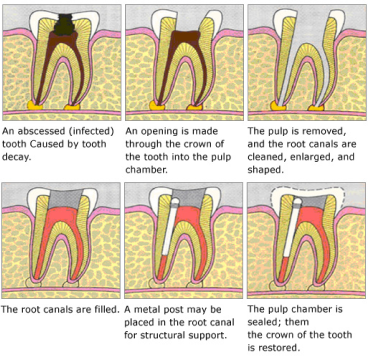
Your dentist may have suggested to you that Root Canal Therapy (otherwise known as Endodontics) was needed for a particular tooth. They may have briefly discussed some of the facts concerning the procedures involved in root canal therapy but perhaps you would like some more information.Years ago, a badly infected tooth, or one that just had significant decay, was doomed to be extracted. Today the majority of these teeth can be salvaged through a procedures utilized by both the General Dentist and the root canal specialist, the Endodontist.Extraction is truly our last resort!
Some indications of the need for root canal treatment may be:
Spontaneous pain or throbbing while biting.
Sensitivity to hot and cold foods.
Severe decay or an injury that creates an abcess (infection) in the bone.
Root canal treatment consists of :
The removal of the infected or irritated nerve tissue that lies within the root of the tooth. It is this infected pulp tissue that causes an eventual abscess.
The first step in a root canal is to obtain access to the nerve. This is accomplished by establishing a small access opening in the top of the tooth. It will be done under a local anesthetic.
The length of the root canals is determined and the infected pulp is removed.
At the same visit, the canal where the nerve is located will be reshaped and prepared to accept a special root canal filling material. This filling procedure will probably not occur until your next visit. The number of visits necessary to complete your root canal will depend upon several factors including the number of nerves in the tooth, the infected state of the nerve and the complexity of the procedure.
The final step in your root canal will be the sealing of the root canal with a sterile, plastic material, called gutta percha This is done in order to prevent possible future infection.