

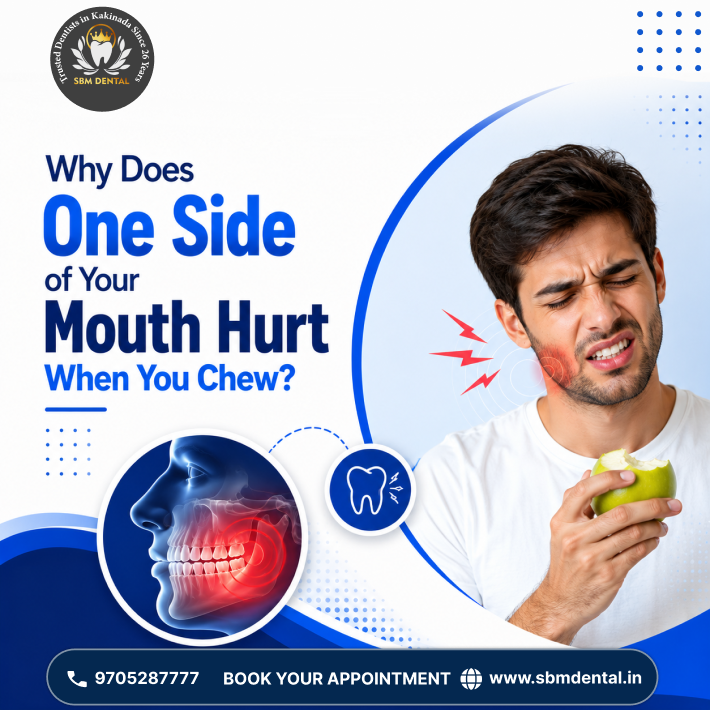
Why Does One Side of Your Mouth Hurt When You Chew?
You sit down for a meal and take your first bite. Everything seems normal until you chew on one particular side of your mouth. Suddenly, you feel a sharp or uncomfortable pain. You switch to the other side, hoping the problem will disappear. If this happens repeatedly, your teeth may be trying to tell you something. One-sided tooth pain can have several causes, ranging from tooth decay to a cracked tooth or gum problem.
Why Does One Side of Your Mouth Hurt?
Chewing puts pressure on your teeth and surrounding tissues. If one tooth is damaged, infected, or sensitive, that pressure can trigger pain.
Some common causes of one-sided tooth pain include:
- Tooth decay
- Cracked or chipped teeth
- Dental fillings that need attention
- Gum infection
- Tooth sensitivity
- Teeth grinding
- Dental abscess
- Food trapped between teeth
The exact cause cannot always be identified without a dental examination.
Signs You Shouldn't Ignore
Pay attention if you also experience:
- Sharp pain while chewing
- Sensitivity to hot or cold foods
- Swelling around the tooth
- Bleeding gums
- Food getting trapped
- Pain that continues after eating
- A bad taste in your mouth
- Tooth sensitivity
These symptoms may indicate an underlying dental problem that requires professional attention.
What Could Happen If You Ignore It?
It can be tempting to simply chew on the other side of your mouth. However, avoiding the painful area does not solve the underlying problem.
Untreated one-sided tooth pain may lead to:
- Larger cavities
- Tooth infection
- Damage to the tooth nerve
- Gum problems
- Tooth fractures
- Difficulty eating comfortably
- More complex dental treatment
Early treatment is generally easier when the problem is identified before it progresses.
How Can a Dentist Help?
Your dentist will examine the affected area and may recommend an X-ray if necessary.
Treatment depends on the cause and may include:
- Dental fillings
- Professional cleaning
- Treatment for gum disease
- Repair of a cracked tooth
- Root canal treatment
- Dental crown
- Treatment for an abscess
The goal is to identify the cause of the pain and protect the affected tooth.
How to Protect Your Teeth
Good daily habits can help reduce your risk of dental problems.
- Brush twice a day with fluoride toothpaste.
- Floss or clean between your teeth daily.
- Avoid chewing very hard foods.
- Limit sugary snacks and drinks.
- Do not use your teeth to open packages.
- Visit your dentist regularly.
- Never ignore recurring pain while chewing.
If one-sided tooth pain keeps returning, it is worth arranging a dental checkup
When Should You Visit a Dentist?
Book an appointment if:
- Pain occurs every time you chew.
- The tooth is sensitive to hot or cold.
- You notice swelling.
- The pain becomes stronger.
- You have difficulty eating.
- The tooth feels cracked or loose.
Prompt dental care can help prevent the problem from becoming more serious.
Conclusion
Pain on one side of your mouth while chewing is not something you should simply get used to. Cavities, cracks, gum problems, and infections can all cause discomfort when pressure is placed on a tooth.
If you experience one-sided tooth pain repeatedly, a dental examination can help determine the cause and the appropriate treatment. Contact us today to book your dental consultation and take the first step toward healthier gums.